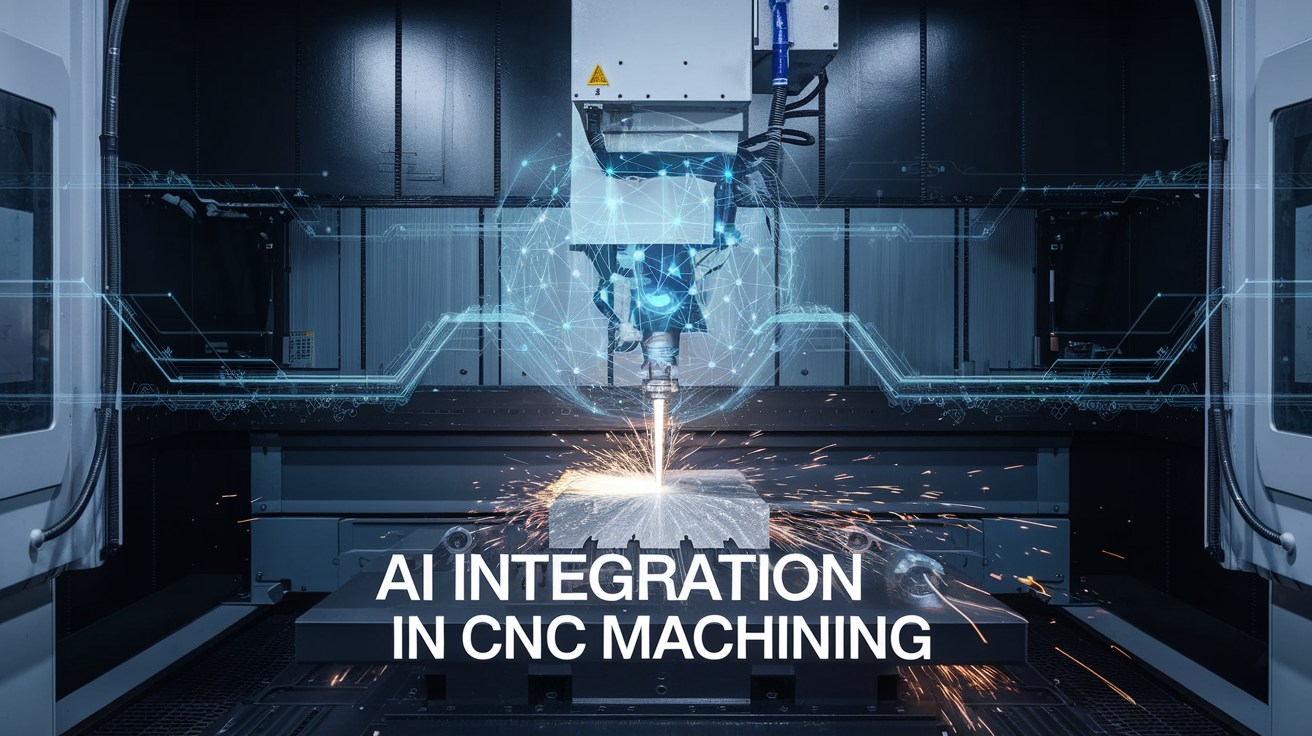
AI Integration in CNC Machining: How Artificial Intelligence is Revolutionizing Manufacturing
Discover how AI-driven machining optimizes feeds, speeds, toolpaths, and predictive maintenance in real-time CNC operations for maximum efficiency.
AI Integration in CNC Machining: How Artificial Intelligence is Revolutionizing Manufacturing
Artificial intelligence is transforming CNC machining from a manually programmed process into an intelligent, self-optimizing manufacturing system. AI-driven machining represents the convergence of machine learning, real-time data analytics, and advanced automation that's reshaping how parts are produced across industries.
Modern AI systems can analyze thousands of machining parameters simultaneously, making split-second adjustments that human operators simply cannot match. This technological leap is delivering unprecedented improvements in quality, efficiency, and cost-effectiveness for manufacturers worldwide.
Real-Time Feed and Speed Optimization
Traditional CNC programming relies on predetermined feeds and speeds based on material specifications and general machining guidelines. AI-driven systems take a fundamentally different approach by continuously monitoring cutting conditions and adjusting parameters in real-time.
These intelligent systems use sensors to track spindle load, vibration patterns, tool temperature, and acoustic signatures during machining operations. Machine learning algorithms process this data stream to identify optimal cutting parameters for each specific situation, accounting for variables like:
- Material hardness variations within the same workpiece
- Tool wear progression throughout the cutting cycle
- Thermal expansion affecting dimensional accuracy
- Chip evacuation efficiency in different cutting zones
- Dynamic machine rigidity under varying load conditions
The result is adaptive machining that maintains peak performance throughout the entire operation. Manufacturers report cycle time reductions of 15-30% while simultaneously improving surface finish quality and extending tool life by up to 40%.
AI optimization doesn't just speed up production—it enables machining strategies that would be impossible to program manually. The system can implement micro-adjustments hundreds of times per second, maintaining optimal chip load even as cutting conditions change dramatically during complex contour operations.
Intelligent Toolpath Generation and Optimization
AI is revolutionizing how toolpaths are created and executed in CNC operations. Traditional CAM software generates toolpaths based on geometric algorithms and user-defined parameters. AI-enhanced systems learn from millions of previous machining operations to generate superior toolpaths automatically.
Machine learning models trained on vast datasets of successful machining operations can predict which toolpath strategies will deliver the best results for specific part geometries and material combinations. These systems consider factors that human programmers often overlook:
- Optimal approach angles to minimize tool deflection
- Strategic rest machining sequences for complex features
- Adaptive stepover patterns that balance speed and surface quality
- Collision avoidance strategies that maintain maximum material removal rates
- Energy-efficient cutting patterns that reduce power consumption
Advanced AI systems can even simulate thousands of toolpath variations virtually, selecting the optimal strategy before a single chip is cut. This virtual optimization considers machine-specific characteristics, including axis acceleration limits, spindle power curves, and structural resonance frequencies.
For high-mix, low-volume manufacturers, AI toolpath generation dramatically reduces programming time while improving first-article success rates. The technology is particularly valuable for complex 5-axis operations where traditional programming requires extensive expertise and time investment.
Predictive Maintenance and Equipment Monitoring
Equipment downtime represents one of the most significant cost factors in CNC manufacturing. AI-driven predictive maintenance transforms machine upkeep from a reactive or schedule-based process into a proactive, condition-based strategy.
AI systems continuously monitor hundreds of machine health indicators, including vibration signatures, bearing temperatures, hydraulic pressures, axis positioning accuracy, and electrical current consumption. Machine learning algorithms establish baseline patterns for normal operation and detect subtle deviations that indicate developing problems.
This approach enables maintenance teams to address issues before they cause failures:
- Bearing wear detected weeks before catastrophic failure
- Ballscrew degradation identified through positioning drift patterns
- Coolant system issues predicted from temperature anomalies
- Spindle imbalance recognized from vibration frequency analysis
- Control system problems anticipated from communication timing irregularities
Beyond failure prevention, AI maintenance systems optimize service scheduling to minimize production disruption. The technology can predict the optimal timing for maintenance activities based on actual component condition rather than arbitrary time intervals, extending component life while maintaining reliability.
Manufacturing facilities implementing AI predictive maintenance report 25-50% reductions in unplanned downtime and 20-35% decreases in maintenance costs. The technology also improves workplace safety by identifying hazardous conditions before they can cause accidents.
Quality Control and Defect Detection
AI integration extends beyond the machining process itself to revolutionize quality control and inspection. Computer vision systems powered by deep learning algorithms can inspect parts with greater accuracy and consistency than human inspectors while operating at production speeds.
These intelligent inspection systems use high-resolution cameras and advanced imaging techniques to detect surface defects, dimensional variations, and material inconsistencies. The AI models are trained on datasets containing both acceptable parts and various defect types, learning to identify subtle quality issues that might escape traditional inspection methods.
Real-time quality monitoring provides several critical advantages:
- 100% inspection without slowing production throughput
- Immediate feedback enabling process corrections before producing scrap
- Detailed defect classification for root cause analysis
- Trend detection identifying gradual process drift
- Statistical process control with automated documentation
Advanced AI systems create closed-loop quality control by automatically adjusting machining parameters when inspection data indicates dimensional drift or surface finish degradation. This autonomous correction maintains consistent quality even as tools wear or environmental conditions change.
The integration of AI quality control with machining operations enables true lights-out manufacturing for many applications. Machines can operate unattended overnight or on weekends with confidence that quality issues will be detected and addressed automatically.
Frequently Asked Questions
How much does AI-driven CNC machining cost?
AI implementation costs vary widely based on machine complexity and desired capabilities. Retrofit solutions for existing machines start around $15,000-50,000 per machine, while new machines with integrated AI systems command 20-40% premiums over conventional models. Most manufacturers achieve ROI within 12-24 months through productivity improvements and reduced downtime.
Can AI systems work with older CNC machines?
Yes, many AI solutions are designed as retrofit systems that integrate with existing CNC equipment. External sensors monitor machine performance and cutting conditions, while edge computing devices process data and provide optimization recommendations. Some systems can interface directly with machine controls to implement automated adjustments, while others provide operator guidance for manual parameter changes.
What skills do operators need to work with AI machining systems?
AI systems are designed to simplify rather than complicate machine operation. Operators need basic understanding of machining principles and how to interpret system recommendations. Most manufacturers provide 2-5 days of training for operators and 1-2 weeks for programmers. The technology handles complex optimization calculations automatically, allowing operators to focus on setup, workpiece handling, and quality verification.
How does AI machining handle custom or one-off parts?
AI systems excel at custom work because they learn from broad machining experience rather than requiring part-specific programming. The technology applies optimization strategies developed across thousands of previous jobs to new part geometries. For truly novel applications, AI systems operate conservatively initially, then optimize parameters as they gather data during the first few parts.
Is AI machining suitable for small job shops?
Absolutely. Small manufacturers often benefit most from AI technology because it amplifies limited skilled labor and maximizes equipment utilization. Cloud-based AI services make the technology accessible without large capital investments, with subscription pricing models starting around $500-2,000 per month per machine. The technology helps small shops compete with larger facilities on efficiency and quality.
Ready to Leverage AI-Driven Precision for Your Next Project?
Unimake Works combines cutting-edge AI-integrated CNC technology with expert manufacturing knowledge to deliver superior parts faster and more cost-effectively. Whether you need prototype development or production runs, our intelligent machining capabilities ensure optimal quality and efficiency.
Get a Free CNC Machining Quote from Unimake Works Today
Upload your CAD files and receive a detailed quote within 24 hours. Experience the difference that AI-driven manufacturing makes.